Silver Tales. Karen Blixen told in silver, pearls and diamonds
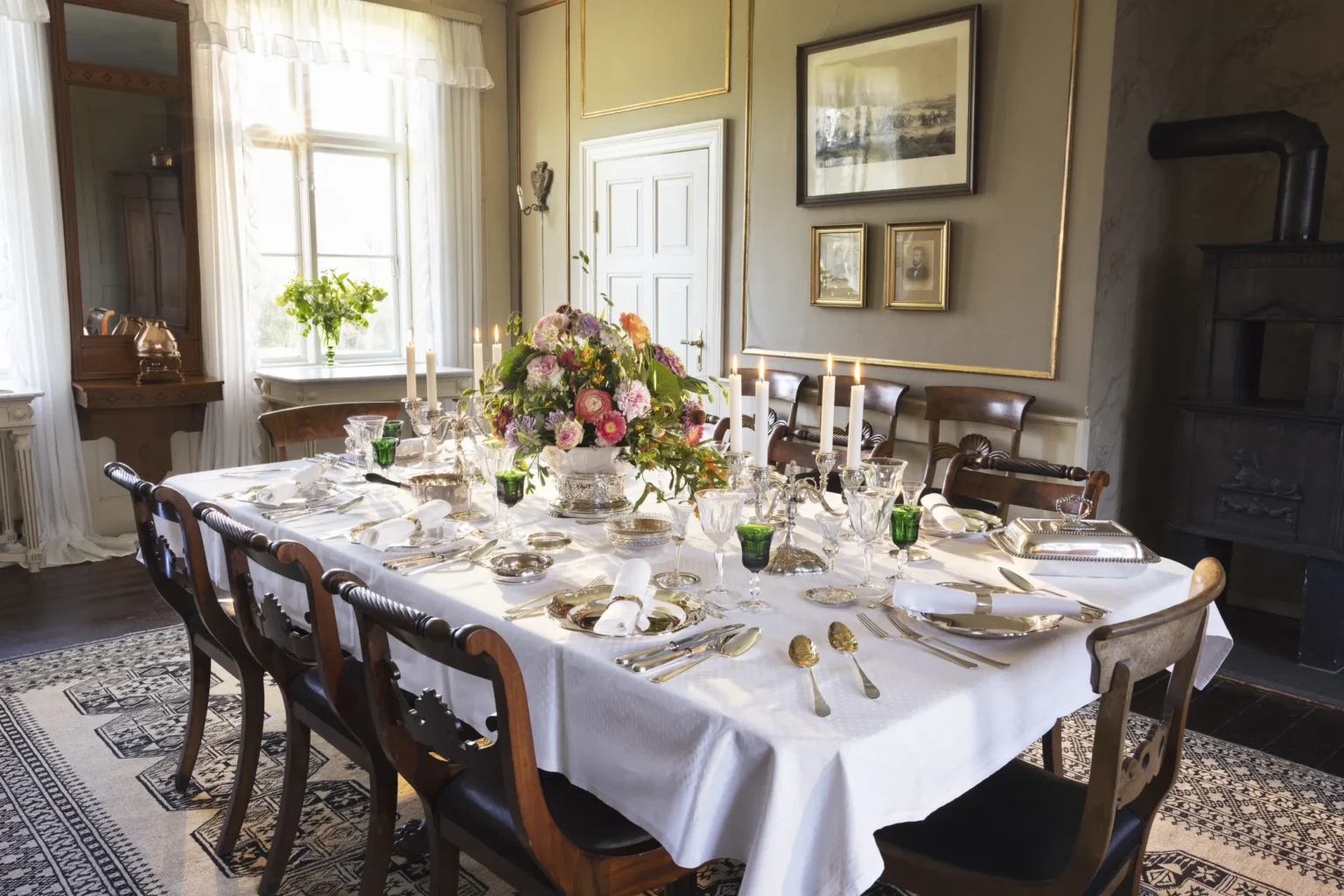
Title of the work: The table setting for Babette’s Feast
Artist: Anne Jallit for Sølvkælderen
Location: Karen Blixen Museum Rungstedlund
Photo of work
Inspiration
In Karen Blixen’s own dining room at Rungstedlund, the authentic dining table is set as if for a hypothetical Babette’s Feast—and Sølvkælderen’s table setting includes various references to the well-known and beloved story. The story takes place in Norway, and Babette is described as being from Paris, France. The silver centrepiece from 1926, seen in the middle of the table, is by silversmith Evald Nielsen (1879–1958); chosen for its beauty and for the text about the North Sea engraved on it. The style is ornate and very finely executed, and the centrepiece was originally made for an anniversary at the steamship company D/S Vesterhavet. The double-fluted cutlery is an old French pattern which, as far as is known, was brought to Denmark by King Frederik VI (1768–1839); the pattern was first used by the royal household, later by several noble families, and then became one of the most beloved Danish cutlery patterns. The plates are a “copy” of the plates that only the particularly wealthy ate from in the 18th century; later they were used as charger plates. Also on the table are two berry spoons representing the fruit: the spoons are from London and feature a gilt bowl (the concave part of the spoon). The lidded dish can be used as a covered serving dish—but it can also be separated and used as two dishes. Napkin rings are a relatively “new invention”; they emerged in France around 1800.
Materials
Sterling silver, three-tower silver, silver plate and steel
Credits
Foto: Miklos Szabo & Ida Buss