Frequently Asked Questions/FAQ
There are lots of questions about silver, and fortunately we can answer most of them. Below, we’ve gathered some of the questions we’re asked most often. If you can’t find the answer to what’s on your mind, you’re of course very welcome to call us or write to us.
Read more about silver as a precious metal, the history of silver, and a few little curiosities that we know people usually enjoy learning more about.
Get answers to your questions
What is silver?
Of all metals, silver has the whitest colour. Silver is the 68th rarest element in the Earth’s crust. It is rarely found pure, as silver readily forms compounds with other metals. Silver is about 30 times more abundant than gold in the Earth’s crust, which is also one of the reasons why gold costs more than silver.
Why does silver tarnish black?
Pure silver is unaffected by water and oxygen, but it is altered by ozone in the air. This forms silver oxide, and on contact with sulphur compounds, silver sulphide forms. Natural and man-made silver alloys also tarnish grey or black when the silver is exposed to sulphur compounds in the air. The thin black/yellowish layer of silver sulphide on the surface is called “tarnish”. It is black and can leave dark marks on the skin. Another example is the hydrogen sulphide content of eggs; it enters into a chemical reaction with silver cutlery.
Where is silver found?
Silver has been found in Cornwall (England), Norway, Germany, Poland, Siberia, Mexico, Nevada, Utah, Colorado, Arizona, Ontario (Canada), Burma, New Mexico, Chile and Peru. Today, the most important silver-producing countries are Mexico, Peru, Australia, the USA, China, Russia, Canada, Chile, Poland and Bolivia.
The history of silver
Silver has been used for royal and ritual purposes and ceremonies for millennia, for personal adornment, and as cutlery and plates for consuming food and drink. For centuries, silver was regarded as a “necessary luxury” one did not wish to be without. The only alternative was the more expensive and rarer gold. Silver was therefore described as an ideal metal: neither as costly nor as heavy as gold, yet valuable as a commodity—something that could be used to create luxury objects, ornaments and coins.
Functional silver for the home
In the past, silver was used in (the wealthiest) households for, for example, bed frames, chairs, tables, mirror frames and fireplace sets—but most silversmithing was used for serving wine. Table silver included everything from goblets and drinking horns to jugs, fountains for serving wine, and spice boxes for storing mulled-wine spices. Silver serving pieces consisted of trays, bowls, napkin rings, pots and pans, egg cups, serving cutlery, plates, gravy boats, salt cellars and other spice shakers, coffee and chocolate pots, teapots, milk/cream jugs, sugar bowls and tongs, cutlery and serving utensils in many varieties, as well as candlesticks.
What is hollowware?
Corpus literally means body in Latin. In silver terms, it refers to objects that can “hold” something—a container of some kind. Corpus, or silver corpus, denotes larger utilitarian objects and craft pieces typically made in sterling silver (925) or 830 silver. Examples include bowls, jugs, candlesticks, trays and boxes.
The difference between a goldsmith and a silversmith
The terms goldsmith and silversmith are misleading, because the difference is not the metals they work with, but what they make and the techniques they use. Goldsmiths make jewellery in both gold and silver, and silversmiths produce hollowware (large utilitarian objects) and cutlery in several metals, for example gold. The techniques and tools differ, but the different smiths may well switch precious metals—so a goldsmith works in silver, and a silversmith works in gold.
925S – what is it?
As with gold, silver fineness is also stated in parts per thousand (‰). The sterling standard—an alloy consisting of 925‰ silver and 75‰ copper—was already commonly used from the beginning of the 14th century and up to today, almost unchanged. The 7.5% copper makes the alloy harder and stronger than if it consisted of pure silver alone, and the alloy has been especially popular for cutlery and hollowware. Silver jewellery was previously also made in 830 silver, but today it is almost always made in 925 sterling silver.
Three Towers silver – what is it?
In some cases, city marks stamped into a silver object have served as a guarantee of the silver content of the item in question, especially if struck by a guild alderman or a guardein (an official responsible for assaying items made of precious metals). King Christian IV (1577–1648) appointed a publicly designated person as guardein in 1608 to check the fineness of all works. As early as 1515 it had been decided to provide objects with a city mark. In 1540, Christian III (1503–1559) wrote that the alderman was to strike the city mark; the Copenhagen city mark was (and is) the three towers. The three towers have had a slightly different appearance since 1608. In Christian IV’s goldsmiths’ ordinance of 1608, the guardein system was introduced: an impartial inspection of all goldsmith work carried out by an official. Copenhagen’s guardein control stamp was the city mark with the three towers and the year. At the same time, the guardein charged a hallmarking fee, and the time of payment was indicated with yet another stamp. Only with the law of 5 April 1888 did it become possible for all the country’s goldsmiths to use the Copenhagen city mark with year as a kind of guarantee mark; at the same time, guardein assaying was made voluntary. The last appointed state guardein in Copenhagen stepped down in 1988. In 1973, Three Towers silver was adopted as 830‰ silver content.
Silver plate – what is it?
Silver plate is base metals plated with silver, sometimes also stamped with two towers. Since around 1840, the silver layer has been applied by electrolysis. Silverware that is only plated with silver usually has a coating 20–30 microns thick; silver-plated jewellery only 3–5 microns. Re-plating can be done by electroplating.
What is a pomander?
Small portable containers for scents and perfumes sit on the border between art and cultural history. They have been used in Egypt since 3500 BC, and in the Ming period (1368–1644) the Chinese produced magnificent flasks for personal use. Preserved Egyptian perfume artefacts in the form of perfume ampoules, jars and flasks are kept in museums, and for millennia artists, craftsmen, gold- and silversmiths, stone carvers and glass artists have been busy fulfilling commissions for these containers. Essential floral oils were difficult to extract, so costly perfumes were a luxury reserved for the few. For that very reason, time was also lavished on the design and workmanship of the flasks. Some of these small works of art were also clear status symbols, as they were worn on clothing in full public view, and were therefore made in precious materials. They are known as pomanders, balsam boxes and “hovedvandsæg”.
Does Sølvkælderen buy my old silver?
Sølvkælderen buys old silver, but mainly with resale in mind. We buy old silverware because we love the craftsmanship, traditions, history and design heritage of silver. Sometimes silverware cannot be saved, and then it is melted down—but some pieces can also be saved through restoration. You are welcome to bring the silverware you would like to sell into the shop, and we will gladly take a look at it, every Wednesday, Thursday and Friday.
Is Sølvkælderen’s silver pre-owned and sustainable?
Vintage, estate, antique—many names for the same thing. For the vast majority of items, Sølvkælderen’s range is pre-owned. This means the green profile is also top-notch, because silverware is sustainable for generations, in some cases even centuries. Antique means something is more than 100 years old, and some of Sølvkælderen’s range truly is. Our goldsmiths, silversmiths and apprentices have inspected every item; if repairs were necessary, they were carried out with care—but perhaps something simply needed a loving, professional polish. Sølvkælderen also carries new, fine pieces by living Danish silversmiths. Finally, Sølvkælderen has proudly sold a great deal of silverware to the Royal Household—among others, Queen Ingrid (1910–2000) was a frequent customer. For Queen Ingrid, Sølvkælderen sold a copy of the Thai royal barge. The royal barge measured about a metre in length and had been in the shop for over thirty years.
Why do silver prices fluctuate so much?
In a turbulent world, some investors turn to commodities such as gold and silver. For the same reason, prices rise—sometimes day by day, or even hour by hour—and you can in fact observe quite dramatic price fluctuations. Over a historical/longer time horizon, you can be relatively confident that gold and silver prices will rise, as the two precious metals also find more industrial applications over time, in addition to the two traditional ones: jewellery and silverware. In general, however, Sølvkælderen does not recommend investing in silver: silverware is something you should buy to enjoy using it and looking at it. If you buy silver for those reasons, you will never be disappointed.
The art of table setting
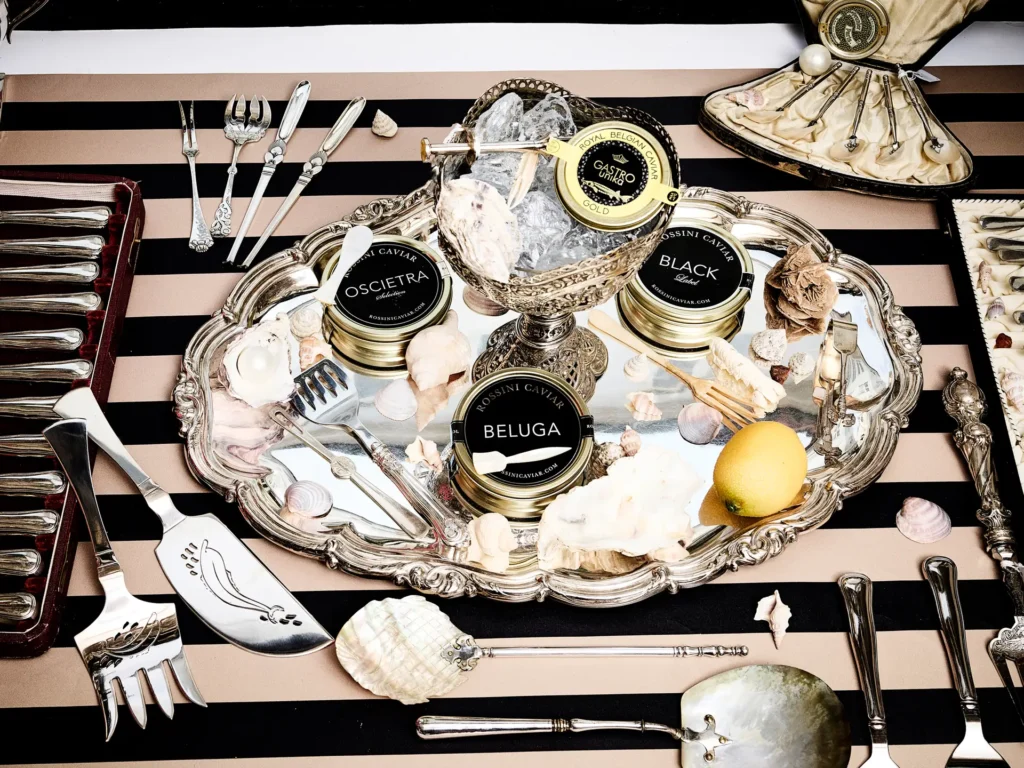
Being able to set a table with silver today is also a way of showing surplus in the form of time and energy, and all types of people buy silver today. There are the regular customers; then there are the first-time buyers, who are usually almost knocked over by the quantities; then there are tourists who return to Sølvkælderen, sometimes with several years in between, and the English have a very lively and very close relationship with silver, so we also supply them—and finally there are the customers who simply want to find something truly special to give, for example as a host gift or as a wedding guest.